 Türkçe
 العربية
 Español
 Français
 русский
 Deutsch

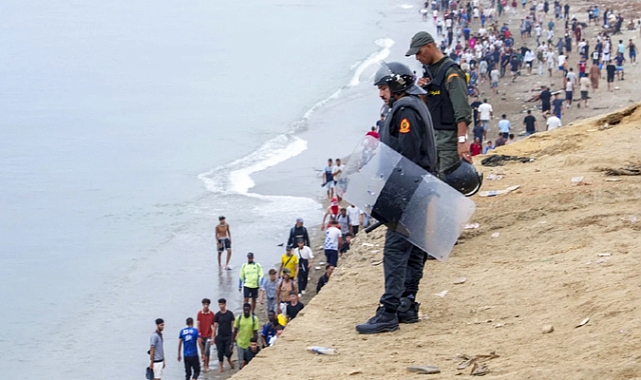

60,000 irregular migrants cross the border as the tragic incident leaves at least 67 dead.Swimming across the El Tarajal crossing had become a steady trickle since the beginning of summer. As the residents of this 18-square-kilometer autonomous city were accustomed to, eight to ten individuals arrived daily on the coast of Ceuta. However, three weeks ago, the Supreme Court ruled that instant deportations (hot returns) of those arriving without bypassing physical borders could not be carried out. This news quickly went viral among Moroccan youth. People began advancing toward the border and crowding around the perimeter. Morocco was aware of this and, as on previous occasions, permitted the initial arrivals: a couple of nights with slightly over a hundred crossings. They seized the opportunity to demonstrate their superiority over Spain. However, according to initial analyses gathered by security sources, Rabat's attempt to manipulate the migration tap spun out of control by Wednesday afternoon. Observers believe that the administration led by Mohammed VI wanted to "use these youths to remind everyone that they are the ones who organize migration, but the situation slipped out of their hands."Security sources explain that the first to arrive were aware of the Supreme Court's ruling because "they organize through social media groups like Facebook or Telegram," and these were supposedly the individuals Morocco allowed through. What the country's authorities failed to account for was what experts dub a "massive pull effect," which led to tens of thousands of people flooding into Spain. According to government sources, a total of roughly 50,000 people crossed in just over 24 hours, while local authorities in Ceuta raised that figure to 60,000. Of those, Moncloa (the Spanish Prime Minister's Office) reported that by 6:00 PM on Friday, 48,300 had returned to Morocco and 57 had died during the crossing. By Saturday, the recovered bodies reached 67.Rabat's Dual Purpose and Local Issues
When Spain and Morocco realized the gravity of the crisis, the Alawite kingdom's "cunning" strategy was to order a shutdown "albeit calmly." This passive attitude was compounded by two chronic internal problems in Morocco: poverty and corruption. Although no one dies of hunger in the country, sources highlight the Gendarmerie's capacity to "turn a blind eye" voluntarily unless given contrary orders. One source summarizes it this way: "They found the spark in the Supreme Court's ruling, saw people crossing, and said: we are not going to do anything."Analysts note that while Morocco did not instigate the crisis, it did permit a massive influx. Rabat's primary goals behind this move are believed to be twofold:Foreign Policy Pressure: Diminishing Spain's room for maneuver by abandoning its traditional role of neutrality as the administrative power of the Sahara, which had long been Madrid's leverage in relations with Morocco and Algeria.Tactical Assessment: Testing the reactions of Spain, the European Union, and the United States to gauge readiness for a future definitive move (such as an attempt to take Ceuta and Melilla).Nevertheless, observers point out that the royal court is fully aware that these autonomous cities serve as "development hubs for two of Morocco's impoverished regions, Nador and Tetuán," making a direct military assault on Spanish sovereignty unlikely in the near term.Experts criticize the Spanish government for repeatedly thanking Morocco for its cooperation and failing to hold them accountable for surveillance failures. Arguing that a policy of appeasement with Morocco never works, sources assert that Madrid needs to project a much firmer stance. Furthermore, claims that organized crime networks or mafias were behind the mass crossing are dismissed; instead, sources note that crossing into Ceuta via Castillejos is a well-known and easy route, and mafias profit from transportation services rather than individuals risking their lives swimming across.Spain's Persistent Security Deficits
The crisis once again exposed Spain's lack of institutional tools and personnel to handle such phenomena. Although the government announced the deployment of 106 reinforcements to the Civil Guard and 200 to the National Police, frontline security personnel emphasize that these numbers fall short in terms of effective street-level presence.Sources from both law enforcement bodies state that these reinforcements "arrived late because the situation was already in a state of collapse." Stressing that "we have learned nothing from the mass influx of 2021," the Unified Association of Civil Guards (AUGC) demands a permanent increase in human and material resources, the expansion of the El Tarajal breakwater, and the designation of Ceuta as a zone of special singularity. Meanwhile, the Justice for the Civil Guard (Jucil) association notes that despite the creation of a specialized unit in early April 2026, shift rotations severely limit active deployment on the ground.The police union Jupol similarly highlights that personnel shortages force riot control units to operate below minimum capacity, describing the Interior Ministry's orders as "improvised." Union sources report that officers are limited to patrolling and only intervening during public disorder because the sheer volume of people leaves no other option. The Ministry supplemented these units with 98 additional personnel working mandatory overtime shifts to manage the situation.
When Spain and Morocco realized the gravity of the crisis, the Alawite kingdom's "cunning" strategy was to order a shutdown "albeit calmly." This passive attitude was compounded by two chronic internal problems in Morocco: poverty and corruption. Although no one dies of hunger in the country, sources highlight the Gendarmerie's capacity to "turn a blind eye" voluntarily unless given contrary orders. One source summarizes it this way: "They found the spark in the Supreme Court's ruling, saw people crossing, and said: we are not going to do anything."Analysts note that while Morocco did not instigate the crisis, it did permit a massive influx. Rabat's primary goals behind this move are believed to be twofold:Foreign Policy Pressure: Diminishing Spain's room for maneuver by abandoning its traditional role of neutrality as the administrative power of the Sahara, which had long been Madrid's leverage in relations with Morocco and Algeria.Tactical Assessment: Testing the reactions of Spain, the European Union, and the United States to gauge readiness for a future definitive move (such as an attempt to take Ceuta and Melilla).Nevertheless, observers point out that the royal court is fully aware that these autonomous cities serve as "development hubs for two of Morocco's impoverished regions, Nador and Tetuán," making a direct military assault on Spanish sovereignty unlikely in the near term.Experts criticize the Spanish government for repeatedly thanking Morocco for its cooperation and failing to hold them accountable for surveillance failures. Arguing that a policy of appeasement with Morocco never works, sources assert that Madrid needs to project a much firmer stance. Furthermore, claims that organized crime networks or mafias were behind the mass crossing are dismissed; instead, sources note that crossing into Ceuta via Castillejos is a well-known and easy route, and mafias profit from transportation services rather than individuals risking their lives swimming across.Spain's Persistent Security Deficits
The crisis once again exposed Spain's lack of institutional tools and personnel to handle such phenomena. Although the government announced the deployment of 106 reinforcements to the Civil Guard and 200 to the National Police, frontline security personnel emphasize that these numbers fall short in terms of effective street-level presence.Sources from both law enforcement bodies state that these reinforcements "arrived late because the situation was already in a state of collapse." Stressing that "we have learned nothing from the mass influx of 2021," the Unified Association of Civil Guards (AUGC) demands a permanent increase in human and material resources, the expansion of the El Tarajal breakwater, and the designation of Ceuta as a zone of special singularity. Meanwhile, the Justice for the Civil Guard (Jucil) association notes that despite the creation of a specialized unit in early April 2026, shift rotations severely limit active deployment on the ground.The police union Jupol similarly highlights that personnel shortages force riot control units to operate below minimum capacity, describing the Interior Ministry's orders as "improvised." Union sources report that officers are limited to patrolling and only intervening during public disorder because the sheer volume of people leaves no other option. The Ministry supplemented these units with 98 additional personnel working mandatory overtime shifts to manage the situation.