 Türkçe
 العربية
 Español
 Français
 русский
 Deutsch


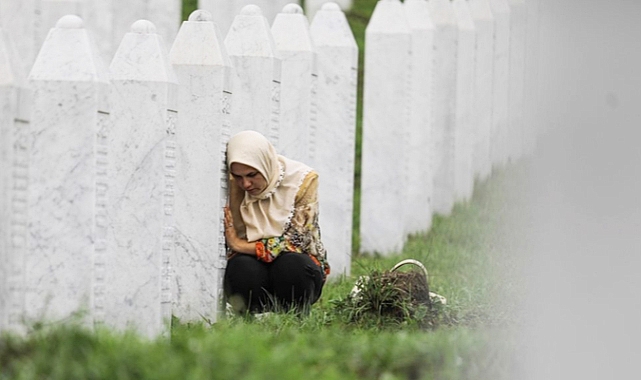
The Bosnian War, which took place between 1992 and 1995, is etched in memory as one of the greatest humanitarian tragedies Europe has faced since the Second World War. While approximately 100,000 people lost their lives and more than 2 million were forced to abandon the lands where they were born and raised, hundreds of thousands of Bosniaks became victims of ethnic cleansing policies, systematic attacks, torture, and grave human rights violations.
The greatest atrocity that became the symbol of this war occurred in Srebrenica in July 1995.
In Srebrenica, which was declared a "safe area" by the United Nations, at least 8,372 Bosniak Muslim men and boys—who were supposed to be under protection—were systematically massacred by Bosnian Serb forces.
Although the figures announced are based on official data, there are strong assessments that the actual death toll is far higher. The International Criminal Tribunal for the former Yugoslavia (ICTY) and the International Court of Justice (ICJ) characterized the events as genocide, and this legal determination has been finalized by international judicial rulings.
However, Srebrenica is not just the name of a genocide.
Srebrenica is also one of the heaviest tests—and, in my view, one of the greatest failures—of international law, the United Nations system, and the international mechanisms created under the pretext of protecting human rights.
Today, when Srebrenica is mentioned, it should not only evoke the thousands of innocent victims slaughtered. It should also serve as a reminder of international institutions that failed to fulfill their duties, states that remained silent, and the collective conscience of humanity.
For this reason, I believe Srebrenica is a dark stain not only on the United Nations and NATO, but on all of humanity that chose to watch while these events unfolded.
The primary perpetrators of the Srebrenica Genocide were held accountable before international criminal courts years later. Bosnian Serb political leader Radovan Karadžić and Bosnian Serb Army Commander Ratko Mladić were found guilty of genocide, crimes against humanity, and war crimes, and were sentenced to life imprisonment.
Although these rulings are significant in terms of international criminal justice, no court decision can bring back the thousands of innocent lives, nor can they soothe the pain of the families left behind.
THE GENOCIDE IN THE UNITED NATIONS' "SAFE AREA"
In 1993, the United Nations Security Council declared Srebrenica a "safe area" for the purpose of protecting civilians. In accordance with this decision, the Dutch UN Peacekeeping Force (Dutchbat) was deployed to the region, and the task of ensuring the safety of civilians was entrusted to this unit.
When Bosnian Serb forces besieged Srebrenica in July 1995, thousands of Bosniaks took refuge in the UN base in Potočari, trusting the United Nations, which had given them assurances. For them, the UN flag was the last hope for survival.
However, that hope soon gave way to an unspeakable tragedy.
Many Bosniaks who believed they would be protected by the United Nations were removed from the area under the control of Dutch UN soldiers and handed over to the control of Bosnian Serb forces. Men and boys were torn from their families; women and children were left behind in despair. Soon after, thousands of people were massacred in systematic executions.
The massacre lasted for days.
People were killed en masse in factories, warehouses, schoolyards, fields, and forested areas.
The bodies were buried in mass graves to erase the traces of the crimes committed. Later, many of these graves were reopened, and the bodies were moved to different regions in an attempt to destroy the evidence.
Despite the fact that nearly thirty years have passed, new mass graves are still being discovered in Bosnia and Herzegovina, and the identified victims are laid to rest each year in ceremonies held annually.
Furthermore, it is assessed that there are many more mass graves whose locations remain unknown.
THE LEGAL RESPONSIBILITY OF THE NETHERLANDS
The events in Srebrenica have been debated for years, not only regarding their historical and humanitarian aspects but also their legal consequences.
Many Bosniaks who took refuge with the Dutch UN Peacekeeping Force stationed in Srebrenica, declared a "safe area" by the UN, surrendered their weapons under the assumption that it was a safe zone; however, the Dutch soldiers handed them over to the Serbs, and they had no weapons with which to defend themselves.
The region declared safe was left under the control of Bosnian Serb forces. A significant portion of those removed from the UN base were killed shortly after in systematic executions. The events there also became a dark stain for the Netherlands. For this was not something a human being would do; those who handed over the innocent to the butchers would one day be held accountable before history.
While all of this was happening, the United Nations, NATO, and the international community were present in the region, and they merely watched.
After years of litigation, Dutch courts accepted the partial legal responsibility of the Dutch State because some Bosniaks under the control of Dutch soldiers ended up in the hands of Bosnian Serb forces.
The United Nations, in its published reports, was forced to admit that Srebrenica was one of the greatest failures in the organization’s history, but this did not bring back those innocent victims.
No court ruling, no official apology, and no compensation could alleviate the pain of the families who lost their children, spouses, fathers, and siblings.
THE WORLD JUST WATCHED
The events in Srebrenica were not a covert operation.
The massacre took place before the eyes of the world.
International organizations that claimed to keep the peace were there. The United Nations was there. NATO was there. The global public followed the developments moment by moment.
Despite this, thousands of innocent people were killed.
Some states contented themselves with only condemning the events. Others did not take effective action for a long time. As a result, the people who should have been under the protection of the international community were abandoned to their fate.
Srebrenica has shown the whole world that international law does not consist only of treaties and declarations; if not enforced, it cannot even protect the most basic human right: the right to life.
Civilians always bear the heaviest burden of wars. Meanwhile, international mechanisms established to protect human rights are often rendered ineffective in the shadow of political interests, economic relations, and strategic calculations.
THE LESSON SREBRENICA LEFT FOR TODAY
Srebrenica is not just a painful event in the recent history of Bosnia and Herzegovina. It is also a historical turning point that questions the sincerity of the international security system, human rights rhetoric, and the global conscience.
The events demonstrated to the entire world the grave consequences that can arise from entrusting a nation's security solely to guarantees given by international institutions. A guarantee on paper means nothing to millions of people if not backed by political will.
International law is undoubtedly one of humanity's common achievements. However, law alone cannot protect innocent people unless there is the will to enforce it.
In my opinion, today, the contributions of the United Nations, NATO, and similar international organizations to global peace—as well as their influence and neutrality during periods of crisis—are being seriously questioned. It is becoming increasingly difficult to say that these organizations can act independently of international power balances. Therefore, I believe their discourse on justice, neutrality, and human rights should be evaluated with a critical perspective.
Srebrenica is one of the most painful examples of this.
The genocide was committed before the eyes of the world. Thousands of people attached their last hopes to the United Nations, thinking they were under international protection. However, what transpired revealed with complete clarity that this trust is not always reciprocated.
For this reason, while states continue international cooperation, they should not neglect their own defense capacities, deterrence, and national security policies. History has shown time and again that leaving security solely to international guarantees can lead to irreversible results.
And it should not be forgotten that...
Every forgotten genocide is a silent danger that can pave the way for new genocides.
CONCLUSION
The Srebrenica Genocide is not just a tragedy experienced by Bosnia and Herzegovina; it is a deep wound opened in the collective conscience of humanity.
In July 1995, thousands of innocent people lost their lives in a zone they were told was safe. Despite the years that have passed, the Bosnian soil continues to yield its missing. New mass graves are found, identification efforts continue, and dozens of families continue to live with the hope that their loved ones will one day be found.
Srebrenica tells us not only of the past; it also issues a significant warning for the future. There is no guarantee that another society will not experience the same situation, and it must be remembered that international institutions cannot be trusted.
Another point that should not be forgotten is that these so-called international peacekeeping forces were established by imperialist powers. Therefore, their founding purposes have nothing to do with peace-keeping or the protection of the victim. The purpose of these organizations is merely the protection of political and commercial interests, and to support and be a part of the construction of a single world order.
It must be remembered that justice cannot be achieved merely by convicting the perpetrators. True justice is possible only by not denying what happened, by not letting it be forgotten, and by creating a collective memory so that similar pain is not experienced again.
Because genocides are first forgotten in the conscience, and then repeated in history.
For this reason, remembering Srebrenica is a moral and conscientious responsibility not only toward the Bosniak people, but toward all of humanity.
The fire should not burn only where it falls. That fire must be felt in every conscience that has not lost its humanity. Because Srebrenica is an indelible disgrace and a dark stain carved into the memory of not only Bosnia, but of the United Nations, the international community, and the humanity that chose to remain silent.
We will not forget Srebrenica.
Neither the silent screams beneath the earth...
Nor the silence of the world that closed its ears to those screams.